
Testing the camshaft position (CMP) sensor on your 1998–2001 3.9L V6 Dodge Ram pickup is easier than you think!
I'm gonna show you three quick tests you can do using a basic multimeter —no scan tool, no expensive gear— to figure out if the CMP sensor's doing its job or it's toast.
I'm also gonna point you to some solid replacement options that won't drain your wallet.
NOTE: The camshaft position sensor is also referred to as the distributor pickup coil.
Contents of this tutorial:
- Symptoms Of A Bad CMP Sensor.
- What the CMP Sensor Actually Does.
- Circuit Descriptions Of The Camshaft Position Sensor.
- Where To Buy The Camshaft Position Sensor.
- TEST 1: Testing The Camshaft Position Signal.
- TEST 2: Making Sure The CMP Sensor Has 5 Volts.
- TEST 3: Making Sure The CMP Sensor Has Ground.
- More 3.9L V6 Dodge Ram Pickup Diagnostic Tutorials.
ES  You can find this tutorial in Spanish here: Cómo Probar El Sensor CMP (1998-2001 3.9L V6 Dodge Ram Pickup) (at: autotecnico-online.com).
APPLIES TO: This tutorial applies to the following vehicles since they use the exact same camshaft position (CMP) sensor:
- 3.9L V6 Dodge Ram 1500 Pickup: 1998, 1999, 2000, 2001.
- 3.9L V6 Dodge Ram 2500 Pickup: 1998, 1999, 2000, 2001.
IGNITION SYSTEM WIRING DIAGRAMS:
- Ignition System Wiring Diagram (1998-2000 3.9L V6 Dodge Ram Pickup).
- Ignition System Wiring Diagram (2001 3.9L V6 Dodge Ram Pickup).
OTHER CMP SENSOR TESTS:
- How To Test The Distributor Pickup Coil (1989-1991 3.9L V6 Dodge Ram Pickup).
- How To Test The Camshaft Position Sensor (1992-1995 3.9L V6 Dodge Ram Pickup).
- How To Test The Camshaft Position Sensor (1996-1997 3.9L V6 Dodge Ram Pickup).
IGNITION COIL TESTS:
Symptoms Of A Bad CMP Sensor
When the CMP sensor goes bad, the PCM (Powertrain Control Module) usually throws one of these diagnostic trouble codes (DTCs):
- P0340: No Camshaft Signal Detected at PCM.
- P1391: Intermittent Loss of CMP or CKP Signal.
But codes aren't the only sign something's wrong. You'll likely notice a few of these other symptoms:
- Engine cranks but doesn't start: The engine turns over but won't fire up. That's because fuel injectors aren't firing correctly. Even if you've got spark at the plugs, the PCM can't sync the fuel timing.
- Random stalling: Sometimes the engine runs fine, then dies out of nowhere —usually while idling or at low RPMs.
- Check Engine Light (CEL): If the PCM sets a P0340 or P1391 DTC, that light on your dash is gonna come on.
- Rough idle or misfires: A weak or jumpy signal from the CMP sensor messes with fuel delivery. That can make the engine stumble, hesitate, or misfire at idle.
- Poor gas mileage: When injector timing is off, the engine burns more fuel than it needs. That hurts your MPG and can even cause black smoke from the tailpipe.
- Hard starting (hot or cold): If the CMP sensor signal is flaky but not completely gone, the engine might eventually start —but only after a few long cranks.
- Sluggish acceleration or hesitation: You may feel flat spots when you hit the gas or slow response when accelerating.
What the CMP Sensor Actually Does
On your 1998–2001 V6 Dodge Ram pickup, the camshaft position (CMP) sensor sits inside the distributor —it used to be called the pickup coil.
It works hand-in-hand with the crankshaft position (CKP) sensor, making sure fuel gets injected at the exact right time.
Here's what it's doing behind the scenes:
- Creates a Fuel Sync Signal:
- When the engine's cranking or running, the CMP sensor sends out a signal called the fuel sync signal.
- This tells the PCM which cylinder is in the compression stroke.
- If the PCM doesn't get this signal, it can't fire the injectors correctly.
- Teams up with the CKP sensor:
- There's also a crankshaft position (CKP) sensor taking readings from the flywheel.
- The CKP reports crankshaft position and engine speed only (no cylinder ID).
- The CMP steps in and gives the PCM the info it needs to match up each crank turn to the correct cylinder.
- Keeps fuel injection in sync:
- The CMP signal helps the PCM fire each fuel injector right when its cylinder needs it.
- Without this timing, the engine won't run right —or at all.
- Helps with spark timing (indirectly):
- While the crank sensor mainly handles spark timing, the CMP gives extra info about cylinder position that keeps things dialed in.
Circuit Descriptions Of The Camshaft Position Sensor
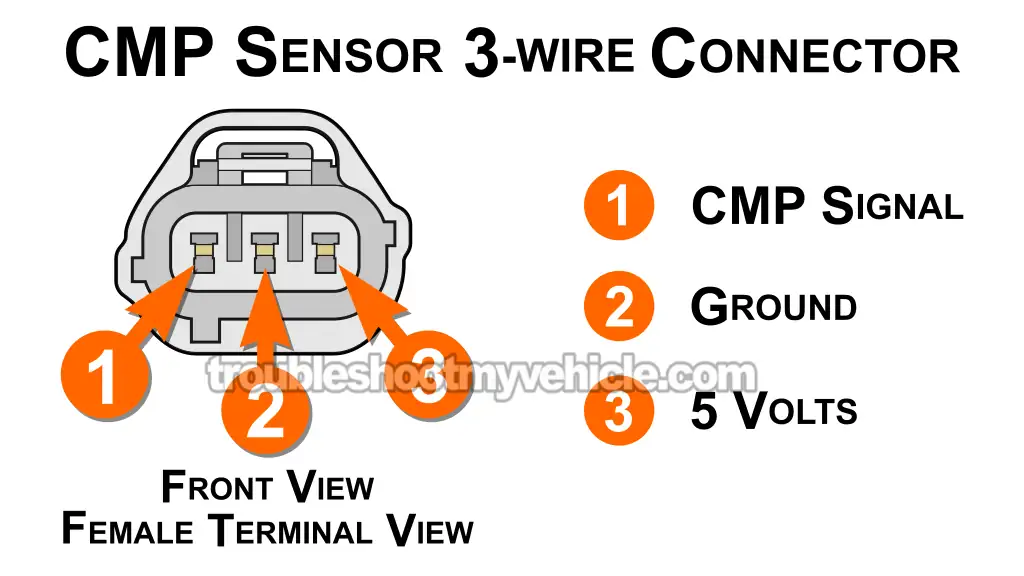
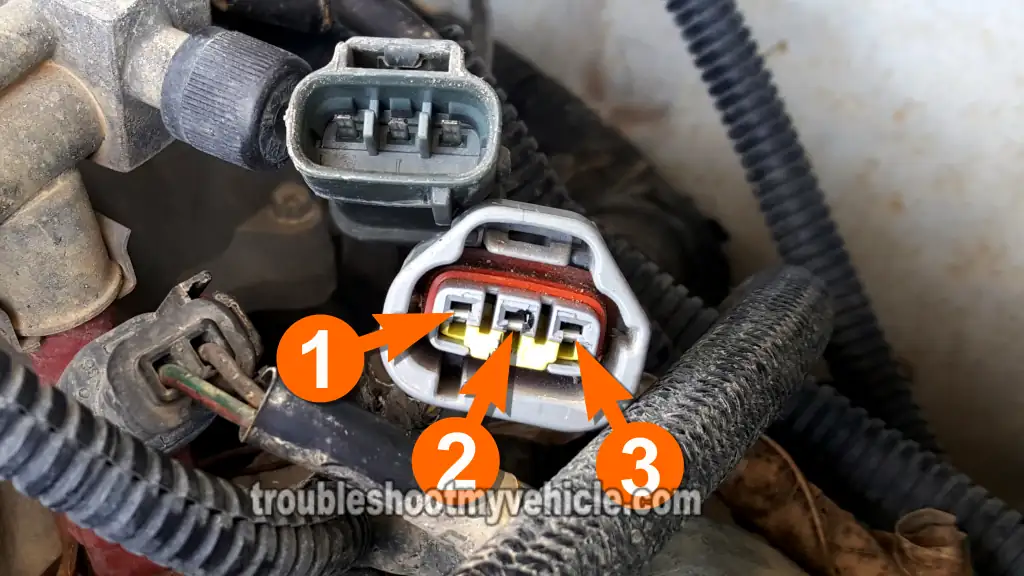
The camshaft position sensor needs both power and Ground to work and send out a signal. That's why you'll see three wires coming out of its connector.
The table below gives you a quick rundown of what each wire does:
| Pin | Wire Color | Description |
|---|---|---|
| 1 | Tan with yellow stripe (TAN/YEL) | CMP Signal |
| 2 | Black with light blue stripe (BLK/LT BLU) | Sensor Ground |
| 3 | Violet with white stripe (VIO/WHT) | 5 Volts DC |
Where To Buy The Camshaft Position Sensor
The following links will help you comparison shop for the camshaft position sensor (distributor pickup coil). I think you'll save a few bucks:


Disclosure: As an Amazon Associate, I earn from qualifying purchases. If my tutorials help you, using these links is an easy way to support the site at no extra cost to you. Thank you!
TEST 1: Testing The Camshaft Position Signal
While the engine's cranking or running, the CMP sensor sends out a voltage signal that flips between ON and OFF. When it's ON, you'll see 5 Volts DC. When it's OFF, it drops to 0 Volts.
Here's the good news —you can catch that voltage flip using a regular multimeter. That's exactly how we're gonna test it.
If the camshaft position sensor fails, it usually stops switching and just stays stuck at one voltage the whole time the engine cranks.
So in our first test, we'll connect a multimeter to the CMP sensor's signal wire and check if the voltage jumps back and forth between 5 and 0 Volts like it's supposed to.
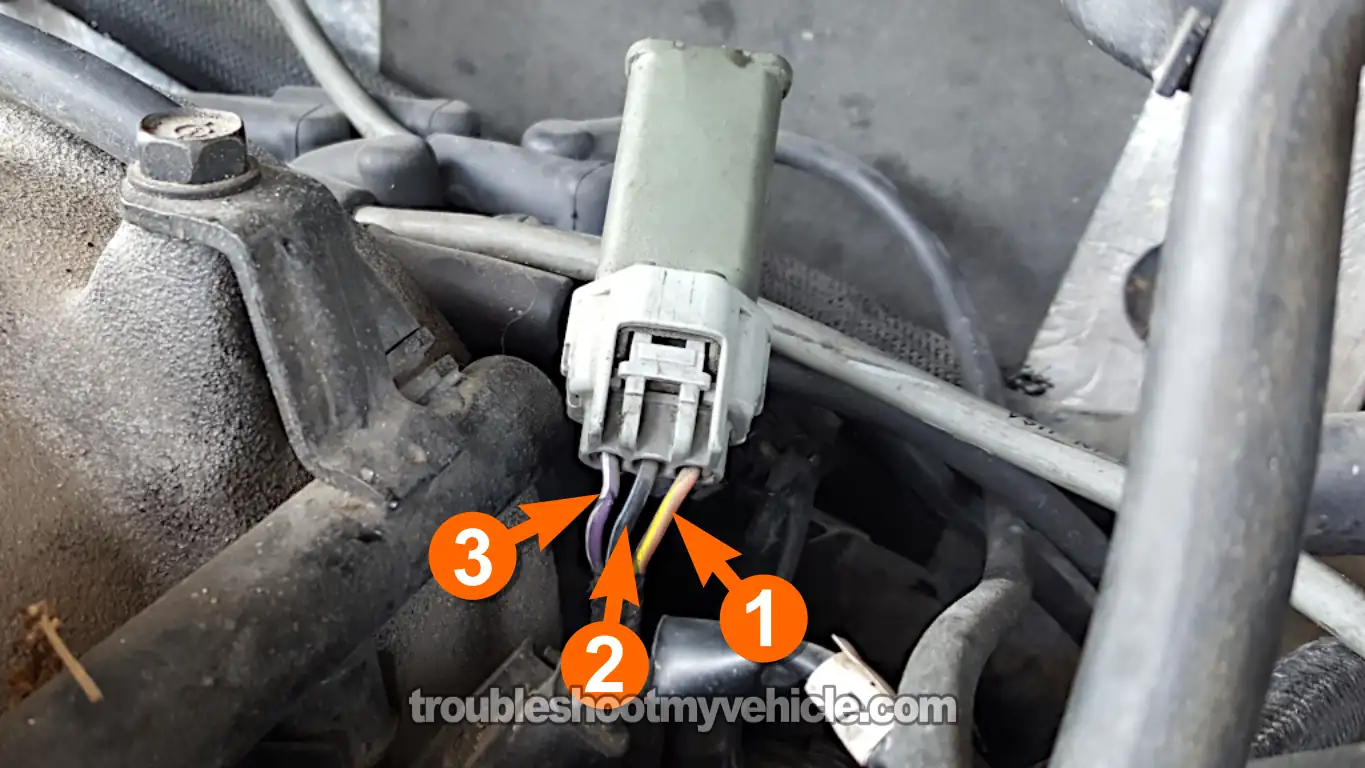
The wire you're after is the tan wire with a yellow stripe (TAN/YEL) —that's the wire that carries the ON/OFF signal.
IMPORTANT: The sensor has to stay plugged into its engine harness connector during this test. You'll need to use a back probe or pierce the wire insulation to read the signal inside the wire. You can see an example of a wire piercing probe here (and you can buy it here too): Goupchn 4mm Banana to Banana Plug Test Leads Kit (Amazon affiliate link).
NOTE: Don't have a multimeter or need to upgrade yours? This is the one I use: Tekpower TP8268 AC/DC Auto/Manual Range Digital Multimeter (at: amazon.com)Tekpower TP8268 AC/DC Auto/Manual Range Digital Multimeter (Amazon affiliate link).
Here's how to run the test step by step:
- 1
Unplug the ignition coil's electrical connector. This step's a safety precaution, it'll keep the engine from starting —don't skip it.
NOTE: Leave the distributor cap on. It holds the camshaft position sensor in place, so it needs to stay where it is. - 2
Set your multimeter to measure DC Volts.
- 3
Connect the black lead from your multimeter right on the battery's negative (-) terminal.
- 4
Tap the red multimeter lead into the tan/yellow stripe (TAN/YEL) wire from the CMP sensor's connector.
NOTE: The sensor needs to stay connected to the engine harness so the signal can be read properly.
CRANKING ENGINE WITH STARTER MOTOR:
- 5
With your leads in place, have someone crank the engine for a few seconds while you watch the reading.
- 6
If everything's working, you'll see the voltage jump back and forth between 5 Volts and 0 Volts DC while the engine's spinning..
NOTE: If you don't see that voltage switching, perform steps 5 and 6 under "CRANKING ENGINE MANUALLY".
CRANKING ENGINE MANUALLY:
- 5
Grab a 1/2-inch ratchet and socket and use it on the crankshaft pulley to turn the engine by hand.
- 6
As the crankshaft turns, the multimeter should show the voltage flipping between 5 Volts and 0 Volts DC.
Here's how to make sense of what you saw:
CASE 1: The voltage switches between 5 and 0 Volts. That's exactly what you want. The CMP sensor is doing its job. It's not the reason your V6 Dodge Ram pickup isn't starting.
CASE 2: Voltage stays stuck —it doesn't flip between 5 and 0 Volts. That usually means the CMP sensor's bad.
But before replacing it, make sure the sensor's getting both power and Ground. Go on to: TEST 2: Making Sure The CMP Sensor Has 5 Volts.
TEST 2: Making Sure The CMP Sensor Has 5 Volts
If you're at this point, that means the CMP sensor didn't show any voltage switching between 5 and 0 Volts during TEST 1.
Most likely, the sensor isn't sending its ON/OFF signal because it's not getting power from the fuel injection computer (PCM).
So now we're gonna test if the violet with white stripe (VIO/WHT) wire is feeding 5 Volts DC to the CMP sensor.
If that checks out, we'll move on and confirm the sensor's also getting a good Ground.
Let's get started:
- 1
Disconnect the CMP sensor from its harness connector.
- 2
Set your multimeter to read DC Volts.
- 3
Place the black lead from your multimeter onto the battery's negative (-) terminal.
- 4
Turn the key to the ON position —but don't start or crank the engine.
- 5
Use the red multimeter lead to probe the terminal that connects to the VIO/WHT wire on the engine harness side.
The VIO/WHT wire is the one that connects to the female terminal I've marked number 3 in the illustration above.
NOTE: Make sure you're probing the connector with the female terminals —that's the one attached to the engine wiring harness. - 6
You should see between 4.5 and 5 Volts on the meter.
Now here's what your results tell you:
CASE 1: You're seeing 4.5 to 5 Volts on the VIO/WHT wire. Perfect —that means the CMP sensor is getting power.
Next up, check if it's also getting a good Ground signal: TEST 3: Making Sure The CMP Sensor Has Ground.
CASE 2: You're NOT seeing 4.5 to 5 Volts on the VIO/WHT wire. Without that power, the CMP sensor can't generate a signal.
That usually means there's a break or open-circuit in the VIO/WHT wire between the sensor and the PCM.
Tracking down the cause of this missing voltage is beyond the scope of this tutorial, but your next step is to find the break and repair the wire.
TEST 3: Making Sure The CMP Sensor Has Ground
The camshaft position sensor also needs a strong Ground connection to send out that ON/OFF voltage signal.
In this final test, we're gonna check the black with light blue stripe (BLK/LT BLU) wire to confirm it's giving the CMP sensor a proper Ground.
IMPORTANT: The CMP sensor gets its Ground straight from the fuel injection computer (PCM). Don't connect the BLK/LT BLU wire to 12 Volts —doing that will toast the computer. The method I'm showing you here is safe and reliable for checking Ground with a multimeter.
Alright, here's what to do:
- 1
Unplug the CMP sensor from the connector.
- 2
Set your multimeter to measure DC Volts.
- 3
Connect the red lead from your multimeter to the battery's positive (+) terminal.
- 4
Turn the ignition key to the ON position —don't start or crank the engine.
- 5
Touch the black multimeter lead to the female terminal that connects to the BLK/LT BLU wire.
The BLK/LT BLU wire is the one that connects to the female terminal I've marked number 2 in the illustration above.
NOTE: Be sure you're testing the harness side —the connector with the female terminals coming from the engine wiring. - 6
Your multimeter should show 10 to 12 Volts DC.
Here's how to read the results:
CASE 1: You're seeing 10 to 12 Volts on the meter. That confirms the sensor's getting the Ground it needs. You're good there.
The CMP sensor is bad and needs replacing if you've confirmed all of the following:
- Voltage didn't switch between 0 and 5 Volts in TEST 1.
- The VIO/WHT wire showed 5 Volts in TEST 2.
- The BLK/LT BLU wire delivered Ground in this test.
CASE 2: Your meter didn't show any voltage. That means there's no Ground, and the CMP sensor can't send its signal.
This usually means there's a break in the BLK/LT BLU wire somewhere between the connector and the PCM.
Tracking down that broken Ground wire is outside what we're covering here —but your next move is to find the issue and fix the wiring.
More 3.9L V6 Dodge Ram Pickup Diagnostic Tutorials
I've written quite a few 'how to' diagnostic tutorials for the V6 Dodge Ram pickup and you can find them in this index:
Here's a small sample of the articles/tutorials you'll find in the index:
- How To Test The Intake Air Temp (IAT) Sensor (1998-2001 3.9L V6 Dodge Ram Pickup).
- How To Test The Fuel Pump (1992-2001 3.9L V6 Dodge Ram Pickup).
- How To Test The TPS (1997-2001 3.9L V6 Dodge Ram Pickup).
- How To Test For A Blown Head Gasket (1989-2001 3.9L V6 Dodge Ram Pickup).

If this info saved the day, buy me a beer!
